
Beyond Resilience: Designing for Instability
The past five years have fundamentally reshaped how supply chain leaders think about network design - I don’t need to say ‘unprecedented times’, ‘new normal’ or ‘resilience’ to create PTSD flashbacks. What was once a relatively stable, optimization-driven exercise has become something far more dynamic and closer to risk management than pure efficiency.
Heading into TPM (Trans-Pacific Maritime Conference) in Long Beach this year, there was a sense across the industry that we might finally be returning to some level of predictability in ocean freight with rates normalizing over the past 12 months, capacity increasing. With global demand not as high as it has been it truly looked like we were all walking into Shipper’s market - unfortunately this feeling disappeared before the conference opened its doors on March 1st this year, with the latest Middle Eastern war in Iran starting a day prior on February 28th.
Presenters hastily rewrote slides, panels were dominated by the emerging contract and carriers began to withdraw contracts, citing the emergency war fees, bunker charges and operating risk. Conversations that had been centered on cost, contracts, and service levels turned toward disruption, rerouting, and exposure. The Strait of Hormuz, as formally unknown to the majority of the globe as Wuhan in 2020, one of the most critical arteries in global trade was suddenly in focus.
This was the seed of an enormous “a-ha” moment for me and my thinking on network design.
For decades, supply chains and the systems that support them have been built on an implicit assumption that the environment we operate in is broadly stable, and that disruptions are temporary deviations from that stability. Networks are designed based on historical flows, systems are implemented based on current processes and we sign contracts based on expected volumes and rates.
Since the pandemic those who were not fluent Business Continuity Plans (BCPs) became Duolingo Diamond League winners and it was considered sufficient to deal with the exceptions. The problem is that the exceptions are no longer exceptional and despite that dreaded ‘new normal’ phrase most Supply Chain leaders have not truly been living it.
Over the past few years, we’ve seen the pandemic, geopolitical tensions reshaping trade lanes and tariff structures, climate events disrupting ports, rail networks, and inland distribution, labor shortages impacting capacity at every node and rapid swings in demand driving both shortages and excess. PTSD might have been an understatement!
Each event has been treated as a disruption to normal, but when disruptions happen continuously, the concept of “normal” starts to lose meaning. This isn’t a particularly radical observation however it has felt to me that the industry’s response has been to fetishize resilience and rely on mostly performative BCP’s rather than address that (I’m going to say it….I’m sorry) new normal.
From Resilience to Volatility-Native Design
Resilience, by definition, assumes a return to a prior state, it assumes there is a baseline we’re trying to get back to. The ‘a-ha’ moment was quite simply “What if there isn’t? What if the environment isn’t stabilizing but evolving?’
It hit me like a lightning bolt that planning now requires a different mindset and instead of designing for stability and planning for disruption, we need to start designing for volatility as the norm rather than mitigating to the model of stability.
Awfully pretentious (always), but this is what I think of as volatility-native design, it’s a shift from asking how do we recover when something goes wrong into how do we operate effectively when things are always changing.
“It’s ok….I’ve hardwired a backup….”
(yet another example of stock image that asks so many more questions than it/I could ever possibly answer)
Business Continuity Planning still has a role to play but in many organizations, it has become performative, there are binders, playbooks, and scenario documents that outline what to do in the event of specific disruptions and they do get reviewed, very occasionally tested, and then put back on the shelf. The most important stage, however, is checking the box that says ‘BCP reviewed’ - the metric is does it exist, not how effective it is.
Sadly, speaking from experience I can tell you that in reality most disruptions don’t follow the script, they overlap, they cascade and they evolve in real time. A BCP might tell you what to do if a port shuts down, it doesn’t tell you what to do when that port shutdown coincides with a demand spike, a supplier delay, and a sudden change in tariff policy.
The issue isn’t that BCP is wrong, as I wrote in the opening paragraph it’s that it was though to be sufficient and it clearly isn’t. We don’t need better contingency plans for a stable world, we need operating models built for a world that doesn’t stabilize.
Structural Implications
If Supply Chain leaders accept that volatility is the baseline, it changes how we think about everything from systems and platforms through to decision making and data.
Systems and Platforms
Most systems are implemented based on a snapshot of the business at a point in time, designed to optimize current processes, current flows, and current volumes. My issues with this is that in a volatile environment, those conditions change and often quickly.
Volatility-native systems are:
Modular rather than monolithic
API-driven rather than closed
Configurable rather than fixed
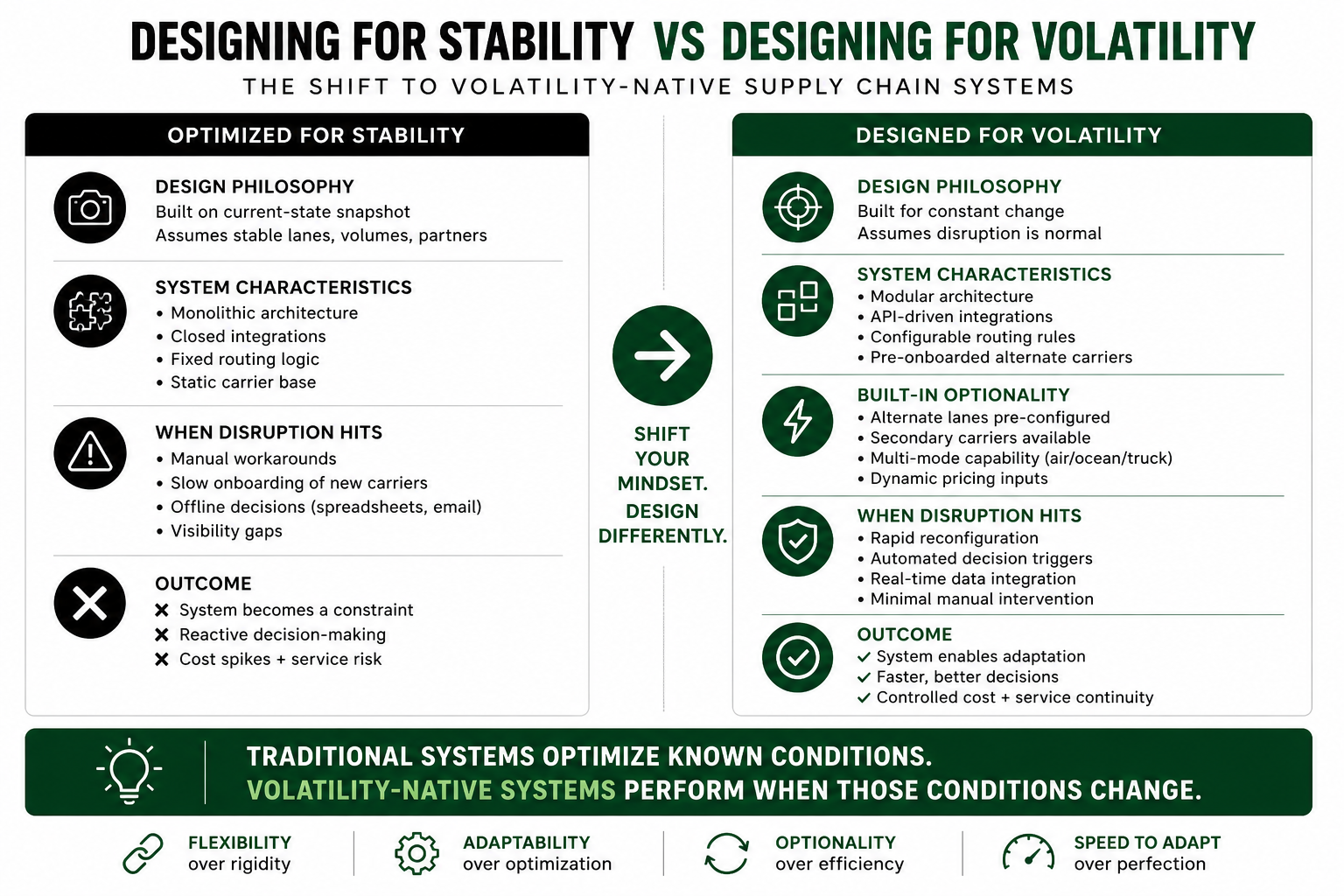
The goal is having the ability to adapt without rebuilding, it means intentionally accepting some inefficiency in exchange for flexibility - an example could be investing in capabilities that are rarely used until they suddenly become critical. Think about the above graphic* in relation to a traditional TMS that has no alternate routing built in, manual approval flows, delay cascades and the impact being felt financially in the moment - now think about a volatility-native system that applies the principles of modularity, accessibility and most critically flexibility. With the war in Iran as a pressing recent example I know which system I prefer!
*AI caveat - I got this graphic generated as it was prettier than my attempt
Capacity and Capability
Traditional network design aims to match capacity with expected demand, with buffers for variability. In a volatile world, variability is the dominant condition and instead of designing for average demand, design needs to encompass rapid scaling up and down, shifting volumes across nodes and regions and multiple fulfillment and sourcing options.
Redundancy, which has historically been viewed as waste, becomes optionality and optionality becomes a strategic asset - the caveat of course being that there needs to be strict controls and parameters to redundancy.
Commercial Structures and Contracts
Long-term contracts (in transportation 12, 24, 36 months) are built on predictability, assuming that volumes, rates, and operating conditions can be forecast with reasonable accuracy. I sincerely wish that was the world we are all operating in, however in a volatile environment, they reduce flexibility.
It doesn’t mean abandoning contracts altogether, but it does mean rethinking their structure. At a recent customer advisory board event I brought this up and leaders from both sides of the table were extremely receptive.
We’re starting to see shorter contract cycles with built-in flexibility and review points, variable pricing mechanisms and, of course, multi-sourcing strategies. Rather than viewing them as signs of instability they should be viewed as mechanisms for managing it - of course there is work to do with budgeting/planning and financial teams to ensure that organizationally everyone is on the same page. This leads to the next structural implication…
Decision-Making and Data
In a stable environment decisions can be optimized over time while in a volatile environment decisions need to be made quickly, frequently with incomplete information. The critical conversation is about visibility and the importance of that visibility - most organizations now have access to more data than ever before and can confuse that for progress.
More data alone ≠ better supply chain.
The challenge is actionability, not visibility, it is who can make better decisions, faster, with the data they have.
Volatility-Native Design in Practice
The most important message I’d like to stress is that volatility-native design is about recognizing that the environment we’re operating in has fundamentally changed and adjusting accordingly. It would be easy to misread and think that I’m advocating for abandoning efficiency or discipline however I see this new mindset as an evolution of the latter.
In practice, that might look like:
Designing networks with multiple viable paths, not just the lowest-cost one
Selecting systems that can evolve with the business, not constrain it
Structuring contracts to preserve flexibility, not lock it in
Building teams that are comfortable operating in ambiguity, not just executing plans
For a long time, best-in-class supply chains were defined by being lowest cost, high efficiency and rigid, tight optimization - these things still absolutely matter but they are no longer sufficient for the VUCA world that for 50 years we’ve struggled to adapt to.
The organizations that will outperform in the next decade are the ones that can adapt quickly, reconfigure effectively and make decisions with confidence in uncertain conditions. A great example would be Toyota through the semiconductor shortage, abandoning their infamous just-in-time (JIT) stocking strategy to ensure there was buffer for demand, gaining continuity and control.
Organizations following these strategies won’t necessarily have the lowest cost at any given moment but they will have the ability to manage cost, service, and risk dynamically in real time providing optionality over pure optimization.
Going back to TPM, the conversation changed hours before the conference even began. The drive was something (depressingly) familiar happening again, this wasn’t unprecedented. It was another disruption, another shift and another timely reminder that stability is not something we can rely on, certainly not with box-checking BCP exercises.
We can keep treating these events as interruptions to normal or we can accept that they are the environment we operate in. Resilience assumes a return to normal, we should be designing for a world where there is no normal and the sooner we embrace that, the better positioned we’ll be to navigate whatever comes next.